 INDOCHINA CARTACARO.COM
A year ago, we promised to unveil Captain Péri’s rare photographs of the 1909 Battle of Yen Thé. Today, the wait is over! Over 80 never-before-seen images are now available.
Alfred Raquez in color
Raquez, the Photographer of Laos
After Fiévet, Planté, and Demange, it is now Raquez’s turn.
Alfred Raquez was the photographer of Laos. His views are magnificent, intriguing, and surprising. They rank among the earliest photographic images of this small landlocked country, nestled between China, Cambodia, Siam, and Vietnam.
Raquez died in Marseille in January 1907, just a few weeks after the 1906 Colonial Exhibition. He had organized the Laos pavilion himself — the photographs, the objects, the people. But he did not publish his own postcards. They appeared after his death, divided into six series, from A to F. One hundred and fifty cards in all.
And these series follow no discernible logic. Neither geographical nor ethnographic, not even common sense. Why does this view belong to Series B, while that one appears in Series D? It is difficult to say. Most likely, whoever assembled the collection knew neither Laos nor its culture and customs. The hand that arranged these cards was at work in France, using photographs brought back from the field — not in Laos itself.
Raquez’s color postcards are uncommon. At the time, a hand-colored postcard was a luxury item, and publishers kept a close eye on the competition. Raquez — or rather, those who published his work after his death — followed the trend.
The colors also reveal the limitations of this edition. Bright, sometimes garish tones. Stenciled color that bleeds and wavers along the edges. Color adds a layer; it does not reveal.
But let us not deny ourselves the pleasure: beneath the stencil lies the eye. And Raquez’s eye belongs to no one but him.
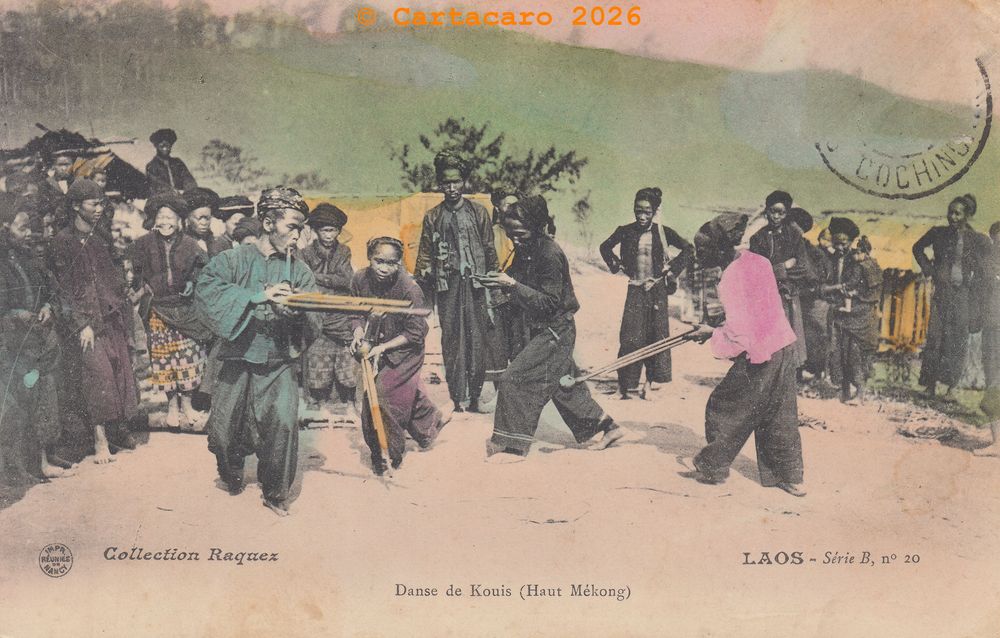
Raquez B 20
Kouis dance - Upper Mekong
Raquez
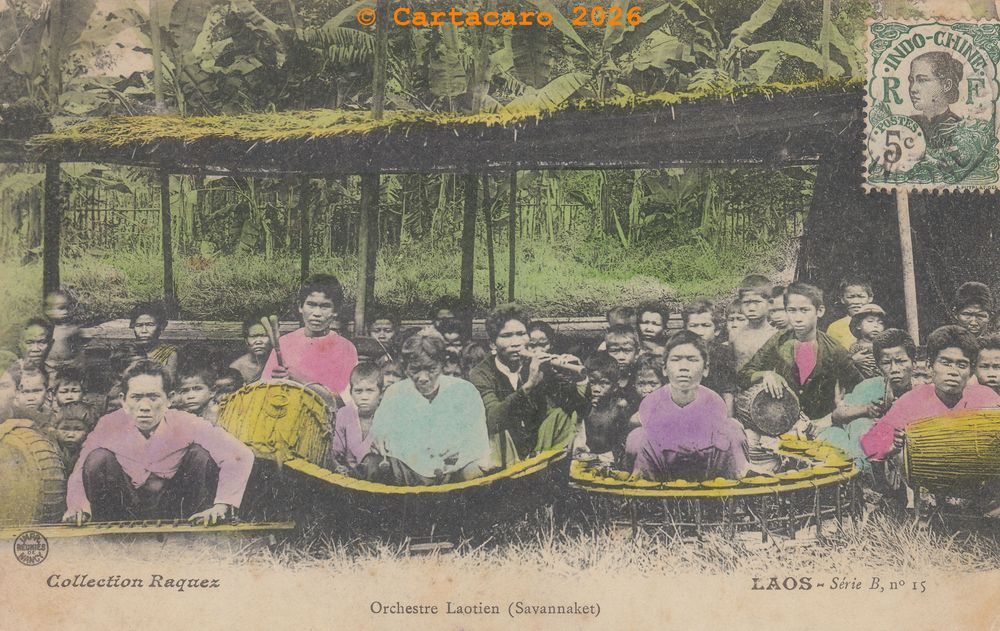
Raquez B 15
Lao orchestra - Savannaket
Raquez
Next
Previous